Chelsea Tadeyeske is the brains and brawn behind a lot of what Pitymilk does, and also the author of the chapbook “It Probably Won’t Work, But its Good to Have a Theory”. In this interview one half of Pitymilk had a chat with the other, but the discoveries are just as illuminating for all of us. Promise.
PITYMILK: You’ve written a lot of books. How do you see “…It’s Good to have a Theory” within your own catalog? How do the pieces and the book over all connect to the lineage of your other collections? How do you see them differing? How would you describe your own work?
CHELSEA TADEYESKE: Looking back, I’ve definitely been drawn to more process-based writing. A lot of it comes from the early chapbooks, which were mostly products of classes I took in undergrad. Some of the super early ones off Plumberries Press are longer pieces stretched to fill the length of the book—i.e. à la Joe Brainard’s I Remember—so there was always an underlying prompt feeding the whole thing.
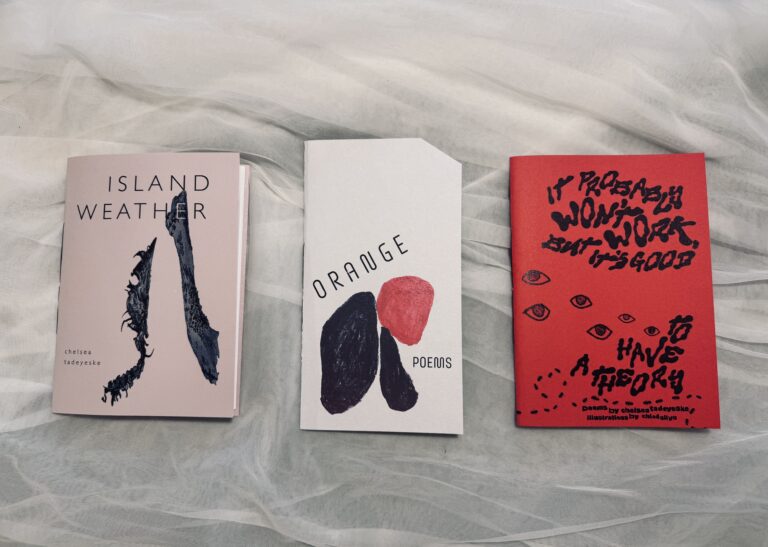
The few we have on Pitymilk are similarly tied to a specific time and place. Island Weather was written in its entirety over 26 days in northern Iceland, and Orange Poems came together—not quite as tightly, but over a couple of months following my grandmother’s passing. There’s something grounding about knowing exactly where and when a book was born or why it has to exist in a more urgent and direct way.
…Theory is a little less “clean” in that sense—or as I like to think of it, not bound by a physical time and space, but more by the motifs I keep returning to across many little eras of my life. Some of the poems here are brand new, and others have been around for a while, but they ended up sharing a universe I didn’t even know could exist until we started putting it together. So in a way, …Theory is a really new modality for me. It was genuinely exciting to watch the pieces start speaking to one another across time—forming these little conversations and worlds I didn’t plan for.
As far as how I like to describe my writing…I’d generally be interested in hearing what you would say. It’s too close to my face sometimes, like, I can’t even see its eyes.
PM: What keeps you writing? What drives you? What are you trying to accomplish?
CT: I think …Theory does a good job at helping me answer this question, actually. There are motifs that reoccur— childhood/adulthood, coming of age and coming to terms, sex and ennui, tragedy and the mundane—the sort of deciphering of emotions that seem to be opposites but also together occupy a completely new, disorienting but intoxicating third space. I often find myself desperate to go here. In this space, things are devastating, profound, inconsequential, hilarious. It is a space I can only access through writing, and a place I want to continue to visit until it doesn’t allow me back in. I need it in order to process life.
PM: You’ve called Milwaukee home for most of your life. How do you think the influence of place finds its way into your work and worldview? Do you see Wisconsin and the Midwest more generally show up in the things you do? What is a Midwestern artist?
CT: The Midwest is kind of like a bubble. There’s a sort of see-through, thin dome over it. It shields you from some the horrors of the world, but you can still see them—clearly. Growing up, the small and large tragedies of the world didn’t escape me, but I was also shielded from most of it to a degree. Of course, things leak in and nothing is perfect, but those in the Midwest are sort of desperate for it to be. That sort of knowing distance, I think, is the thing that found it’s way into my work informed by the Midwest as a place, perspective, etc.
It’s also a humble place, and a place where many people can make things happen in a more grassroots capacity that might be more difficult in a faster-paced, chaotic environment. There’s simply way less noise, and sometimes that can lend itself to you settling into a larger picture. Coming into my own as an artist within a broader community of people making and doing things together still very much influences me and how I make and share art. DIY ’til I die.
PM: Speaking of the Midwest, back in April when the book came out, Pitymilk toured out to Nebraska. This was your first time to Omaha, a place that is really significant to you in many ways. Tell us in your own words why that is? How has that place influenced your art and yourself as a person?
CT: It felt right to try to honor the reason I became a poet in the first place: my favorite band, Bright Eyes. I’ve been an avid fan since I was 13. Conor Oberst really pioneered this kind of overly saccharine but urgent, gorgeous emotional delivery in art that has deeply shaped who I am as both a writer and performer. On the surface, the threads between my work and theirs might seem pretty disparate, but I can actually tease out a pretty direct conversation.
When we knew we were going to tour for the book, I had to ask myself whether I wanted to take the well-trodden Midwestern path or fling myself a little further out. Going to Omaha felt not just viable but necessary, so we made it the center of our mission for this tour. I hadn’t really given much thought to those two days we’d set aside to go there—but when we arrived, it was immediately palpable. Being in the place that birthed Oberst, Bright Eyes, Saddle Creek, and the whole Omaha DIY scene sent this nostalgic pang into my chest. It felt like a home I was finally getting the chance to embrace.
I wasn’t expecting to think as much as I did about life before the internet age, but Omaha also made me deeply nostalgic for a time that felt connective and alive—doing something that hadn’t yet been exploited or flattened. That magical energy around Saddle Creek’s continued legacy is still very much present there, and witnessing that firsthand was super special.
PM: I don’t think many people would immediately consider your work to be overtly political – but the way you embody the anxiety and crushing weight of modernity is definitely not without a social commentary. What is the responsibility of art in an age of increasing suppression and tension? How do you see what you do in relation to the world at large?
CT: I do get a little concerned that my work comes off as naval-gazing or too myopically my experience, but ultimately I want it to ignite a feeling within the audience, that they too can distill their life into poems. It’s a really cathartic way to not only connect to yourself but everyone you may share it with. Poetry is for everyone, like, literally. I want someone off the street and someone leading a classroom to read a poem of mine and not only understand it, but also feel it. Otherwise, what kind of statement are you making if only a select few people can truly access your work?
In grad school, I went through a traumatic situation where a professor publicly deemed my work “whiner aesthetic” in a super derogatory way. I felt embarrassed, devalued—like my work didn’t matter and it didn’t have any weight—that I was talentless. I wasn’t very confident in myself as a person or an artist at that point, and it sort of led to a messy downward spiral that almost cost me my degree. At the time, I didn’t know how else I could express myself. I didn’t know how to not “sound” like that. I didn’t know how to corral my emotions in a way others thought was more worthy of academic attention. I cared too much about what an old, dusty white man thought.
On the other end of that experience, I learned to not abandon my natural way of producing art, and just embraced it even more. I made a shirt with iron-on fabric letters that spelled “whiner” and wore it during my university showcase performance just to spite that asshole. My whines grew, quite literally, louder, and I realized that that is the strength of my work. There is an embodied political. Your lived experience matters. To shit on the confessional is really missing the point of the inherent power it holds to galvanize people across so many unique, but shared oppressions and experiences. It gives us all a world to sit in together and scream. It helps us both witness, hold, and release together.
PM: Tell us about Chloe Allyn – your visual collaborator for this book. How did you get connected to them? Have you worked with them before? The tone of the images is different from your previous collections, they feel a little more comic-esque and light-hearted — how do you find the interplay of that tone with the tone of your poems?
CT: I met Chloé after a series of really cool dominos falling—I went on a mini poetry tour with some friends, and one of our dates was in Appleton where we met and read with Chloé. That night was a forcefield of energy—midway through the show, it started storming out of the blue, as it does in summer, and in the tiny break in rain afterward, she decided to hike back to her house on her moped. I remember thinking Wow, this is one of the coolest people I’ve ever met when she sped off. She’s one of those types of people that everything she touches is automatically cool, mysterious, intriguing, sexy and just plain good art. Before …Theory, we worked together on a micro-chapbook from her publishing outfit, Only Child, called Pity Child. It was an insane opportunity to make something with her and share some space with her poetry.
When I thought about who would be a good visual fit for …Theory, Chloé automatically came to mind. I knew she knew my work, and I also thought that the tonality of her visual art would be a good palette cleanser for the weight of some of the poems. I was interested in seeing what would result if we pit those two worlds together. It kind of reminds me of the nature of my work—like, trying to melt disparate sensations in the same space for a surprising result. I think it worked, and I’m very happy with it.
PM: What’s your favorite conspiracy theory? Do you believe in Bigfoot? Who’s the sexiest monster?
CT: My favorite conspiracy theory is that everything will be okay.
lol, jk.
I believe Bigfoot is real in so much as it is a thing that appears in public discourse, and has real effects on real people. But, I’ve never seen one.
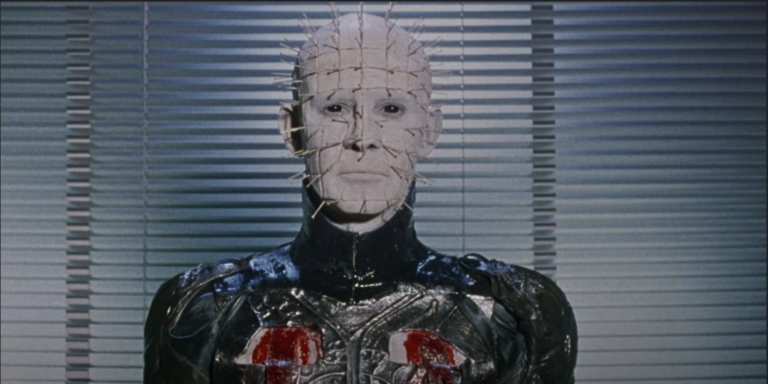
Hmmmmm….maybe Pinhead.
PM: Who are you reading, listening to, watching lately? Whose art is turning your cranks? Who’s inspiring you? Who is challenging you?
CT: I used to be a projectionist in undergrad for the university’s arthouse theater. One day, I laced up Béla Tarr’s The Turin Horse, and realized no one was there. I hopped down and watched it with almost zero context. Durational cinema! I was completely changed. The monotonous suffering, the morbid allegory for life, the incessant wind and cello—the potatoes!! I’d seen many films up to that point, but I feel like the art I seek out is less about a plot or genre—and more about an experience—and how that experience becomes symbolic in my life. It’s my favorite movie of all time and I’ve only seen it once up until a few weeks ago when my local cinema played it in their series called Bleak Week. I wept. It will take another 15 years for me to watch it again.
So, art or an art experience that feels like you are transplanted someplace else, ripped from the fabric of a shared reality, that’s the stuff I live for and probably also why my proclivities are towards high-end dramas and well done horror. Outside of consuming films, I’ve been super slowly reading Walking Through Clear Water In a Pool Painted Black by Cookie Mueller, working my way in and out of John Ashbery collections, and also diving into some Cathy Wagner archives–more exciting news about Cathy forthcoming. I’m making it a sort of goal to consume work that doesn’t sound like me at all until I can grow another writing appendage. I really want to challenge my form and voice for my next collection, so I’ve been drawn to a little more of an objective perspective in an attempt to step outside of myself.
PM: What’re you working on now? What are you excited about? What’s on your horizon that ppl should be anticipating? Where can people follow along with what you are up to?
CT: Summer is hard for me—the heat makes it so hard to process anything. I’m trying to feel inspiration that will propel me forward, but I also want to absorb as much as I can for later use when my body and brain can move more productively. You know, when there’s a breeze. Summer is such a bodily experience, my brain be not so good in it.
There are so many projects in a sort of purgatory right now, as many writers can relate, that I would love to revisit—some that are modalities differing from poems ever-so-slightly. Some that may require I commit them to memory and rely less on a page. I do miss playing with form in a way that disrupts and excites performance. You can expect to see some play within all of that….gotta keep ‘em on their toes. My artist website is not in a great place—for now, you can find me ‘Zucked on IG @pity_milk.
Put your hands on Chelsea’s newest “It’s Good to have a Theory…” or level up hard and scoop a stack of all three of Chelsea’s books in one convenient bundle.
Attest to the Midwest. Long Live Small Press.
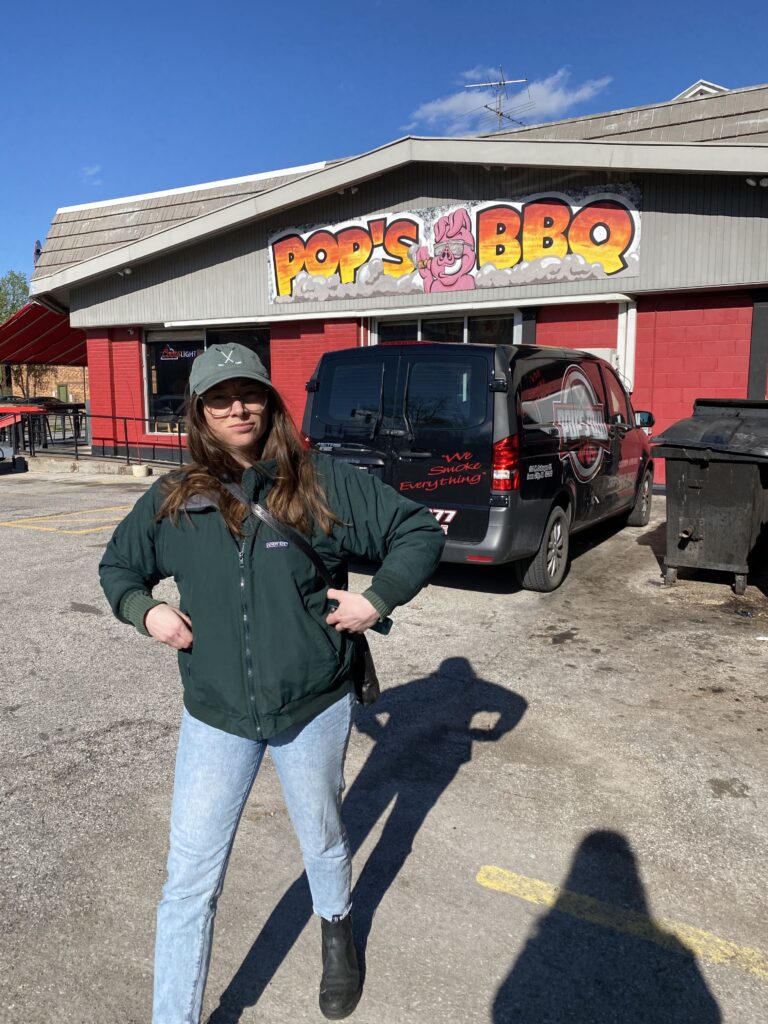
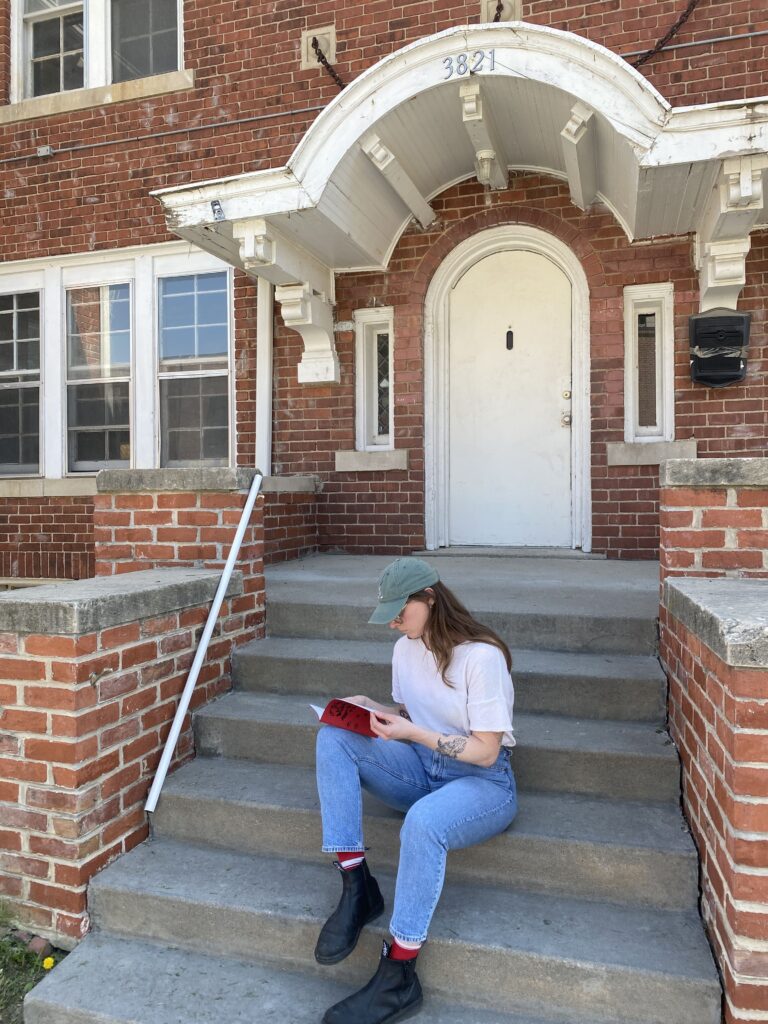
Chelsea reading in front of Hotel Frank in Omaha, NE — April of 2026