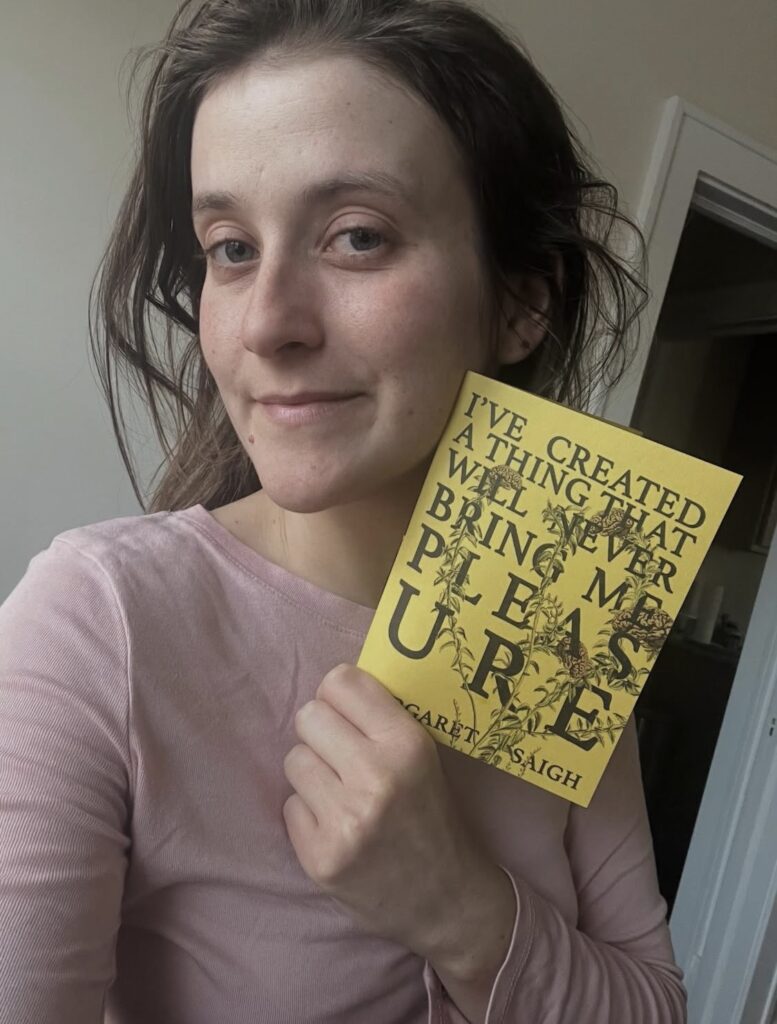
Pitymilk: We are so excited about I’ve Created a Thing That will Never Bring me Pleasure, we were really excited to see that you sent it to us for consideration during our last open call. Would you say there is something (a theme, a perspective, a process, etc.) that holds the collection together? Did the poems arise from a particular context? In your own words, how would you describe the collection?
Margaret Saigh: I think the collection—and to an extent all my poems—are about searching for meaning in a profane world. I’m quoting a writing professor who said that to me and it stuck. I wrote these poems between 2019 and 2022 so during the height of the pandemic and lockdown. I was in my mid-twenties. I had just moved to Pittsburgh for grad school and in the second semester everything locked down for covid. The intense loneliness and abject terror of the era comes through in the images. I like to think of the collection as something of a journey. The first poem—Pilgrim—marks an arrival and the last poem, Caoin, which is an Irish word meaning to keen or lament, is imagining a kind of extinction. The final poem was really inspired by Lord Byron’s “Darkness”
PM: So who would you say are your creative heroes? Who’s writing really got you writing? Whose writing keeps you writing today? What record(s) could you never live without?
MS: Ariana Reines’ A Sand Book was a huge influence for this collection. I read that book three times back-to-back during the first lockdown in March 2020 so her voice was really in my head. Though she wrote it before covid, the poems were so prescient as to what would unfold soon after it was published. Her commanding and prophetic tone really shaped the poems in Pleasure. I really admired how maximalist A Sand Book was, how far the reader and the speaker traveled; the intense mind-bending journey of the speaker in A Sand Book, which to my knowledge basically chronicles like 6-8 years of Reines’ life, sort of gave me permission to write a book that similarly wound and traveled from places both banal and mystical.
As for my favorite writers, work that got/keeps me writing— Satan Says by Sharon Olds, Autobiography of Red and “The Glass Essay” by Anne Carson, Dear Jenny, We Are All Find by Jenny Zhang, The Master Letters by Lucie Brock-Broido, Emily Dickinson’s envelope poems (in The Gorgeous Nothings), Wallace Stevens’ later poems, Songs of Innocence and Experience by William Blake
As for records, Court and Spark and Blue by Joni Mitchell, Bad Girls (Deluxe Edition) and Four Seasons Of Love by Donna Summer, Songs In The Key Of Life by Stevie Wonder.
PM: In addition to the chap, pitymilk had the opportunity to publish some of your work in DUETDUET 10 alongside Detroit Poet Rose Schwartz — tell us how those pieces compare or contrast with the work in “I’ve Created a Thing…”, are these two offerings a good introduction to your voice and perspective? Do they speak to one another in any way? Did you enjoy the dance with Rose? Would you do it again?
MS: I love the concept of DUETDUET and I love Rose’s work! Her poems tended to be a bit longer than mine, so yes I thought the balance between mine and hers was excellent. My poems in DUETDUET are actually newer then the poems in “Pleasure”; in my mind duet poems are a bit more restrained, which I think is a natural progression of growing as a writer. I feel like my voice and perspective change slightly with each individual poem I write and hugely with each collection I revise and complete. Yet all of it is discernible as “me.”
And yes, I definitely think Duet and “Pleasure” offer a good introduction to my poetry, to the kinds of images and sensations I’m drawn to, to the relatively stream of consciousness style I write in.
PM: Speaking of a dance, Pitymilk co-editor Edie Roberts responded to your chapbook with a collection of collaged images — how do you feel they did in capturing some of the vibes of the text? Were you happy to see how those came out? Any favorites?
MS: I love how the collages punctuate the collection. My favorite collage was the one at the end: the geese with the gladiolus tail feathers. I loved how it came after the book’s back-matter as a final coda, like we finally see the sky mentioned at the end of the final poem. In a more general sense, I loved the collage because it brought together two disparate things (flowers and geese) and made it make sense: seeing other things in the thing being presented–it’s the essence of simile, which is maybe the most incredible aspect of human imagination.
PM: We hear through the grapes that you will be hitting the road a little bit soon? Tell us about your relationship to performing and or seeing poetry performed, what makes a good reading? How do you want to be engaged? How do you think the relationship to audience differs from the page to the stage?
MS: Reading is the most important part of my poetry practice (besides the writing process). Reading poems, meeting other writers, watching people absorb and be affected by your poems, it is the best feeling in the world. Reading regularly and in public is far more important to me than having a notable publication record.
When I anticipate reading I am always nervous, But once I begin reading a poem I feel locked into this safe but powerful place because, really, it’s just me and the poem (I know that sounds a bit cheesy but it’s true) and I have great confidence in my poetry.
PM: What’s your favorite conspiracy theory? Do you believe in Bigfoot? Do you trust in the supremacy of THERAPY? How do people most often get in their own way?
MS: Conspiracy theory: Paul Hollywood doesn’t know anything about baking and GBBO is protecting his image as an “expert baker”
Never really thought about Bigfoot except when I see jeeps with the Bigfoot sticker decal and then I think, okay, that’s Bigfoot.
I generally believe therapy is good for people, assuming you have a good therapist.
People get in their own way by living in front of screens and by not caring for anything/anyone beyond themselves.
PM: What’s next for you? Anything exciting coming up? Anything you want to turn us onto? How do people keep up with what you are doing? Any last words of advice?
MS: I plan to keep performing my poetry at readings. I’m going on a mini-tour for “Pleasure,” looking to add more dates if anyone reading this hosts a reading series. I’m also looking for a publisher for a full-length poetry manuscript called Please Get Back (some of the poems from DUETDUET are in that ms). I’m going to continue my other writing project, which right now is a series of critical /creative essays about the poet Lucie Brock-Broido. I have an essay about her coming out in Little Mirror.
Other things not strictly related to writing: making chiffon cakes, collecting vintage pyrex, savory galettes, taking the dog for walks in the park, looking closely at rocks and plants, https://usedworkclothing.com for work clothes.
If you want to keep up, read my writing! You can follow me @circlet_poetry on instagram, but I passionately hate the app and only log on to post about writing stuff. I never reveal much on the apps though,—that’s what writing is for.